 CanCareer
How to prepare for a job interview when you're starting from zero
Most interview advice assumes you already know the moves. If this is your first interview in a while, or your first one in a new country, that advice can feel like it was written for someone else.
Here's the good news: interviews reward preparation more than talent. People rarely lose an interview because they couldn't do the job. They lose it because they walked in cold, got surprised, and never recovered. A simple routine fixes most of that, and you can run it in about 30 minutes.
Here's the routine.
Start with the company, not your nerves.
Before you rehearse a single answer, spend ten minutes learning what the company actually does. You're looking for a few specific things:
- What do they sell, and who buys it?
- What does this team or role contribute to that?
- Anything recent, a product launch, a new office, a mention in the news you can refer to.
You don't need to become an expert. You need two or three concrete details you can work into your answers, so the interviewer hears that you cared enough to look. "I saw you just expanded to Calgary" beats "I'm a hard worker" every time.
Predict the questions before they're asked.
Most interviews are more predictable than they feel. Nearly all of them include some version of:
- Tell me about yourself.
- Why this role, and why here?
- Tell me about a time something went wrong.
- What questions do you have for us?
Write down a few short stories from your real experience, one for each likely question. Keep each one simple: the situation, what you did, and how it turned out.

If your strongest experience is from another country, it still counts. Name it plainly and explain the result in terms a local employer will recognize.
You are not memorizing a script. You're making sure you're never left blank.
Practice out loud, not in your head.
This is the step almost everyone skips, and it's the one that matters most.
Reading your answers silently feels like practice. It isn't. The first time you say the words out loud should not be in the room that decides whether you get hired. So say each answer out loud now. Record it on your phone and listen back, you'll hear the rambling, the filler, the place you trailed off. Then say it again, a little tighter.
It feels awkward. Do it anyway. Saying your answers out loud, hearing them, and trying again is a completely different kind of preparation than reading them quietly, and interviewers can tell who has done it.
If you have a coach, use them.
If you came to CanCareer through a program, a settlement agency, a college, or a nonprofit, you probably have a coach. This is exactly the moment to use them.
Book time before the interview, not after. A coach who already knows your background can do what no checklist can: tell you how to frame experience an employer might undervalue, push back on an answer that isn't landing, and steady the nerves that come from not knowing the unwritten rules. Asking for that help isn't a sign you're behind. It's what the support is there for.
No coach? Run your answers past one person you trust. Even one out-loud rehearsal with a real listener beats ten in your head.
The 30-minute version.
When you're short on time:
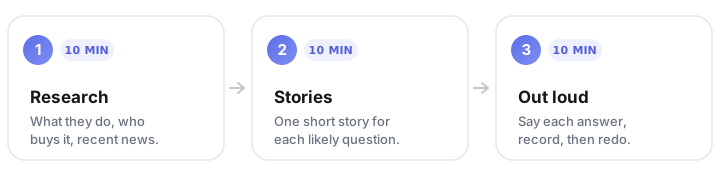
- 10 minutes — research the company and find two or three details to mention.
- 10 minutes — write four short stories, one for each of the questions above.
- 10 minutes — say them all out loud once, record, and redo the worst one.
That's the whole thing. Not because more isn't useful, but because this is the part that changes the outcome.
Where we're headed.
Today, CanCareer helps you find better-fit jobs and tailor your resume to the work behind the posting. We're working on bringing this interview routine into the product too: a quick brief on the company and role, the questions you're likely to face, and a way to practice your answers out loud and get feedback before the real thing.
Until then, the routine above works on its own. Pick the next interview on your calendar and run it: ten minutes of research, ten of questions, ten out loud. You'll walk in warm.